Showing posts with label Kamakura. Show all posts

Sunday, May 17, 2015

Kōtoku-in, Hase-dera, and Inamuragasaki

While visiting Kamakura we saw the Great Buddha (Daibutsu) at Kōtoku-in temple. At almost 44 feet it is the second tallest bronze buddha in Japan. Cast seven and a half centuries ago, this statue has survived eathquakes, a tidal wave, and many storms. It was originally housed inside a temple, but it was destroyed. They allow you to go inside the statue to view the sophisticated (at the time) techniques that were used to form the sculpture. Their website is full of all sorts of fun facts like the height and diameter of the 656 hair coils. 
The street in front of the temple is full of fun souvenir shops. The statue on the right is Buddha holding mochi.
You can hire a rickshaw to take you around town.
We also visited Hase-dera, It is a huge temple complex built on a mountain slope. You ascend stairs in levels and the large temple building is at the top. It has a beautiful view of Kamakura city and the bay. It is most famous for its wooden statue of Kannon, the goddess of mercy, but it contains several shrines intended to honor different deities. 
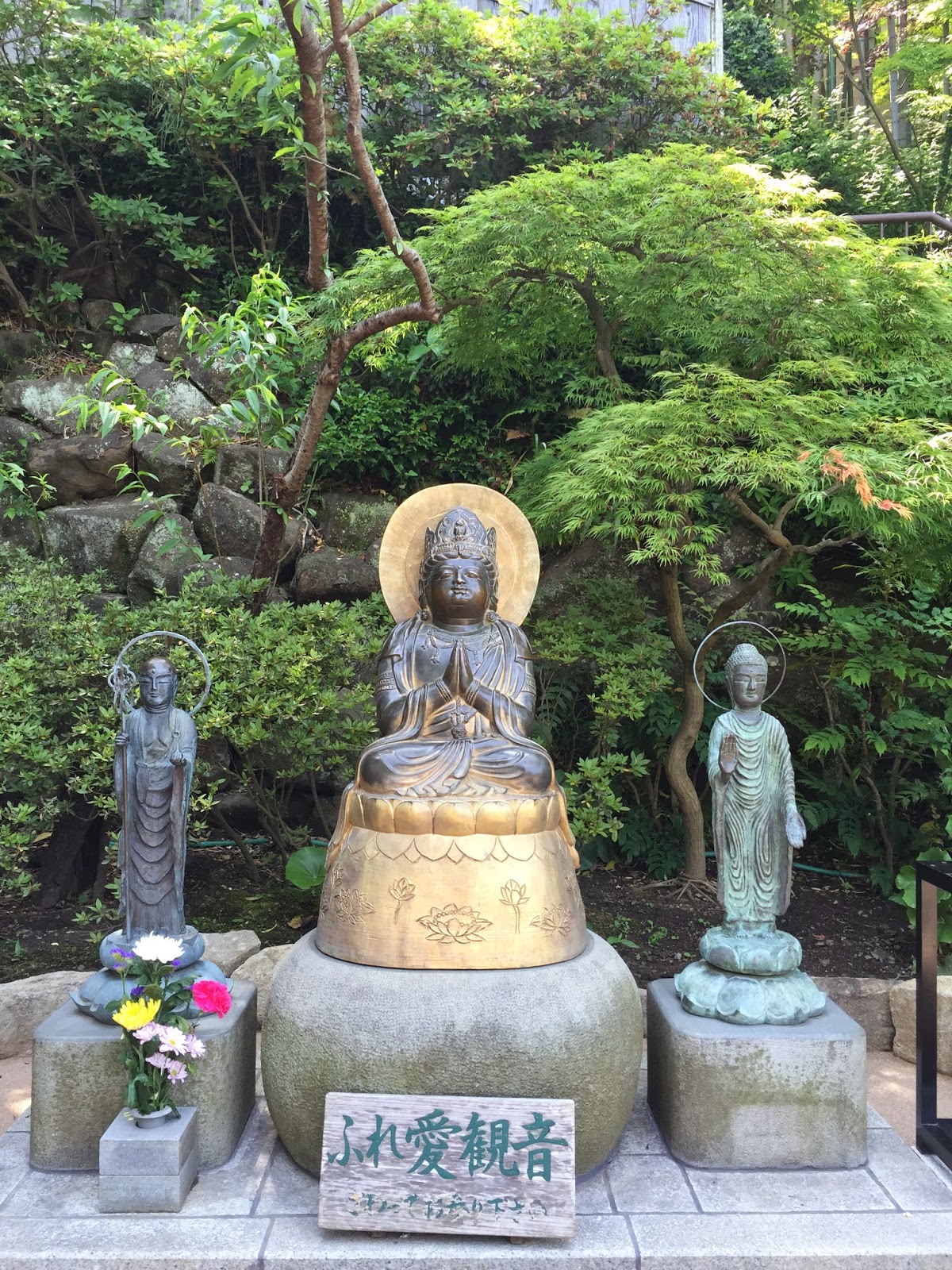
The grounds are also home to hundreds of Jizo Bodhisattva statues. They are placed here by parents mourning the loss of a child. These statues stay on the grounds for about a year before being burned or buried to make way for more. It is estimated that some 50,000 statues have been placed here since WWII. It is so sad to see these sweet little statues and know that they represent a little life lost. Sometimes the parents will dress them in little aprons and beanie hats to keep them warm. 

You can pray for the babies by caring for and washing this little statue.
Hase-Dera is home to one of the largest wooden statues in Japan. Here is the story behind it from Wikipedia:
According to legend, the statue is one of two images of Kannon carved by a monk named Tokudō in 721.[1] The camphor tree was so large, according to legend, that he decided that he could carve two statues with it. One was enshrined in Hase-dera in the city of Nara, Yamato Province, while the other was set adrift in the sea to find the place that it had a karmic connection with. It washed ashore on Nagai Beach on the Miura Peninsula near Kamakura in the year 736. The statue was immediately brought to Kamakura where a temple was built to honor it.

This cave is called Benten Kutsu Cave and it is dedicated to Benzaiten, the sea goddess.  
A beautiful example of a zen garden.
Lovely ladies wearing kimonos
The train is packed!
We also visited Inamuragasaki which is a beautiful beach where on a clear day you have an amazing view of Mount Fuji. 
THIS is what I was hoping to see:
Instead it was a pretty foggy day so we didn't get to see the mountain, but it was still a nice beach with a lot of surfers there for a competition. 
Tiny Japanese streets, I'm not sure how they get their cars down through here, but they do!
That evening we were able to have dinner with our friend Brittany. We met Brittany back in Annapolis where she was part of our YSA group. It is crazy to see how much life changes in such a short period of time. We went from dating our midshipman to married with babies living in Japan. Ridge and Brittany have a beautiful daughter and another little girl on the way in just a few months. It is so nice to see a familiar face! Eisley loved playing with Liliana.


Map Links:
Kōtoku-in
Hase-dera
Inamuragasaki

Ōfuna Kannon and Zeniarai Benzaiten Ugafuku Shrine

David and I had the opportunity to make a day trip to the beautiful town of Kamakura. It's a little out of the way, but definitely worth the side trip! Our first stop is actually a little north of the main area of Kamakura, but it was my favorite. It is one of the most symbolic and beautiful places I have been. Ōfuna Kannon watches benevolently over the homes and businesses near Ōfuna train station. She is the "Goddess of Mercy of the White Robe". Construction began in 1929 and was finally finished in 1960. The statue was formed of concrete poured entirely by hand. 

The literature provided at the shrine states: 
"It contains stones carried from ground zero of Hiroshima and Nagasaki, which commemorate the souls of these who died as a result of the atomic bomb attacks
The Ofuna-kannon-ji is part of the Kamakura District, but due to its location it doesn't form part of the series temples and shrines that are popular amongst sightseers visiting Kamakura City. As a result, those who call at Ofuna-Kannon will find that over 60% of their fellow visitors are individuals with a critical belief who visit the temple on a regular basis for spiritual purposes.
Despite Asia's cultural diversity certain symbols and icons are visible throughout, providing common links between various nationalities. Kannon is such a symbol, and her statue at Ofuna provides a welcome sense of familiarity to foreigners living in Japan who seek her out as a source of comfort during periods of solitude and homesickness. The goddess of mercy carries the prayers for peace of foreigners and Japanese citizens alike."
Overall the meaning of this monument struck home to us as Americans living in Japan. We have already been impressed with how the Japanese in general react to us. Instead of being filled with hatred and bitterness, they treat us with kindness and respect. It is such a short period of history that separates us from being enemies and killing 129,000 of their family members and friends. Especially with Japan being an aging culture, and us living only and hour away from Nagasaki, there are people that we will come in contact with that lost grandparents, parents, and siblings. They are such a forgiving, wonderful people.
From the plaque:
Flame of the Atomic Bomb
The atomic bomb dropped on Hiroshima brought death to hundreds of thousands of citizens. The flame taken from the conflagration burning in "deep-seated pain and memory" of those who were killed, has been kept burning at Hoshino-mura Village in Fukuoka Prefecture.
This flame was lit from that flame and is placed here as a symbol of our yearning for lasting peace. 
To commemorate the 45th anniversary of the Atomic Bombing of Hiroshima and Nagasaki, August 6 and 9, 1945.
Kanagawa Association of A-bomb Sufferers July 29, 1990.

Followers make clothing for these statues as an offering of devotion. I love the mother and baby.
As I was taking a picture of David holding Eisley a Japanese man came up and gestured that he would like to take a picture of us. I went and stood next to David. He took a picture with his camera and my phone for me. He then communicated with limited English and hand gestures that what he really wanted was to take a picture of me taking a picture of David and Eisley. It was a strange request but we complied. There are going to be a lot of weird pictures of our little family on random Japanese cameras before we end up leaving here. 
You can go inside the statue to visit this little shrine.
        I would say Ōfuna Kannon is a must visit if you are in Japan.
I am really impressed with the food in the train stations in Japan. There are legitimate restaurants and pastry shops. We enjoyed lunch at Beckers before heading on our way again. 


Zeniarai Benzaiten Ugafuku shrine was next on our list. It was founded in 1185. You walk through a tunnel carved into the mountainside to emerge in a tiny valley surrounded by mountains. Here you can find strong elements of both Buddhism and Shintoism. They air in the valley is heavy with the smell on incense and there are several different shrines present, all built into the mountain and connected by stairs and narrow pathways.
The reason this shrine is so popular among the Japanese and tourists alike is this spring inside a cave. It is believed that if you wash your money in the spring then it will be returned again to you many times and you will be prosperous. We will let you know how that goes for us!


Map Links:
Ōfuna Kannon
Zeniarai Benzaiten Ugafuku Shrine